



Shelf Label Holder Manufacturing in Nigeria Retail shelf label holders form a foundational element of modern store operations across Nigeria’s expanding supermarket, hypermarket, pharmacy, and specialty retail networks. These components secure price tags, promotional cards, barcode labels, and digital shelf edge displays while withstanding constant handling, temperature fluctuations, and high foot traffic. Firmalazım operates as a dedicated manufacturer serving this demand, producing holders engineered for local environmental conditions and retail formats ranging from open-air markets adapted into formal stores to large-format chains in Lagos, Abuja, and Port Harcourt.
The Nigerian retail sector continues to formalize rapidly. Independent grocers convert into organized outlets, pharmacy chains expand into secondary cities, and international-style supermarkets open new locations. Each new or renovated store requires reliable shelf-edge systems. Firmalazım supplies holders that address the practical realities of Nigerian retail—dust, humidity variations between coastal and inland regions, frequent restocking by staff, and the need for quick price changes during promotional periods or currency fluctuations.
Material Selection for Nigerian Retail Environments
Shelf label holders must perform under conditions that differ from temperate markets. Firmalazım selects polymers and metals based on observed durability in local stores rather than generic catalog specifications.
Polypropylene and ABS blends dominate because they resist cracking under repeated insertion and removal of labels. These materials maintain flexibility in air-conditioned interiors and do not become brittle in non-cooled secondary locations. Firmalazım tests batches against typical Nigerian ambient temperature ranges before release.
Aluminum extrusions appear in higher-end installations where a premium visual finish is required. The metal conducts less heat than steel alternatives and resists corrosion in humid coastal cities. Firmalazım finishes aluminum holders with powder coatings formulated to reduce fingerprint visibility and simplify cleaning by store staff.
Transparent polycarbonate options allow labels to remain fully visible while protecting them from moisture and handling. Firmalazım produces these in both rigid and slightly flexible profiles so that they can accommodate uneven shelf edges common in older store fixtures.

Design Variations Matching Store Formats
Nigerian retail formats range from dense urban minimarkets to large warehouse clubs. Firmalazım develops distinct holder profiles for each.
Front-facing clip systems suit narrow gondolas where space is limited and staff must change prices quickly. The design allows single-handed insertion, reducing labor time during peak restocking hours.
Channel-style holders integrate into metal or wooden shelf edges. Firmalazım machines these channels to tight tolerances so that labels stay secure even when customers lean against shelves or when heavy products are placed nearby.
Magnetic-backed versions attach to steel shelving without permanent modification. This approach proves useful during temporary promotions or in stores that reconfigure layouts frequently. Firmalazım calibrates magnet strength to hold labels under vibration from nearby refrigeration units yet still permit easy repositioning.
Production Processes Used by Local Manufacturers
Firmalazım runs extrusion, injection molding, and secondary finishing lines configured for the volumes typical of the Nigerian market. Extrusion lines produce continuous profiles that are cut to standard shelf depths or custom lengths requested by large chains. Injection molding creates specialized clips, end caps, and multi-label carriers.
Secondary operations include ultrasonic welding for multi-part assemblies, screen printing of branding or instructional marks, and packaging designed for humid warehouse storage. Firmalazım maintains tooling that can switch between standard retail profiles and pharmacy-specific narrow holders without long changeover times.
Quality checkpoints occur at material incoming, after extrusion or molding, and before final packaging. Dimensional checks verify that holders accept common Nigerian label sizes without forcing or leaving gaps. Firmalazım records batch data so that any field issues can be traced to specific production runs.
Compatibility with Existing Shelf Systems
Many Nigerian stores operate mixed fleets of imported and locally fabricated shelving. Firmalazım designs holders that fit both European-style gondolas and locally welded frames. Universal clip geometries accommodate shelf thicknesses ranging from 18 mm particle board to 2 mm steel.
Adapters and extension pieces allow older installations to accept newer label formats without full shelf replacement. Firmalazım supplies these transition components so that retailers can upgrade labeling systems gradually rather than in one capital-intensive step.

Cost Structures and Total Ownership Considerations
Initial purchase price forms only part of the decision. Firmalazım calculates cost per shelf meter over a three-to-five-year horizon that includes replacement frequency, labor for label changes, and losses from missing or damaged price tags.
Thicker wall sections and reinforced clip points raise unit cost yet reduce breakage rates observed in high-traffic Lagos stores. Firmalazım presents side-by-side projections showing when the higher-spec holder becomes the lower total-cost option.
Bulk orders for new store openings receive volume pricing, while smaller maintenance quantities remain available through distributors. Firmalazım structures logistics so that reorder lead times stay short even for secondary cities.
Installation Practices Observed in the Field
Store teams often install holders during night resets or before grand openings. Firmalazım provides simple mechanical fixing methods that require only basic hand tools. Snap-fit designs eliminate the need for adhesives that can fail in humid conditions or leave residue on shelves.
Training materials focus on correct orientation and spacing so that labels remain readable from typical customer viewing angles. Firmalazım has documented cases where improper installation led to labels falling during busy periods; the guidance therefore emphasizes positive retention features.
Maintenance and Cleaning Cycles
Dust and product residue accumulate on shelf edges. Firmalazım selects surface finishes that tolerate daily wiping with common retail cleaners without clouding or cracking. Smooth profiles reduce places where dirt can lodge.
Periodic inspection for cracked clips or deformed channels forms part of recommended store procedures. Firmalazım designs holders so that individual damaged sections can be replaced without removing an entire shelf run, limiting disruption.
Integration with Digital Shelf Labels
Electronic shelf labels are appearing in higher-end Nigerian stores. Firmalazım produces hybrid holders that secure both traditional paper tags and electronic modules. Power and data routing considerations influence the channel geometry so that cables remain protected yet accessible for maintenance.
The transition period between paper and digital systems can last several years. Firmalazım supplies dual-purpose holders that allow stores to convert aisle by aisle without discarding functional hardware.
Supply Chain and Localization Advantages
Import dependence creates exposure to currency swings and port delays. Firmalazım sources polymer resins and aluminum billets through a mix of local and regional suppliers while maintaining finished-goods production inside Nigeria. This structure shortens response times when a retailer opens multiple locations simultaneously.
Spare-part availability remains higher for locally manufactured holders. Firmalazım keeps common profiles in regional warehouses so that a broken clip does not leave a shelf unlabeled for weeks.
Performance Under High-Traffic Conditions
Urban Nigerian stores experience intense customer density during peak hours and promotional weekends. Firmalazım validates holders through accelerated wear testing that simulates repeated label changes and incidental contact. Reinforced contact points and rounded edges reduce both product damage and customer complaints.
In pharmacy environments, holders must remain secure despite frequent small-item retrieval. Firmalazım offers narrower profiles that keep labels visible without protruding into the limited aisle space typical of many pharmacy layouts.
You might also be interested in this topic. Custom Shelf Label Holders in Oman
Customization for Brand and Category Needs
Large chains request color-matched or logo-embossed holders to reinforce store identity. Firmalazım runs limited custom tooling for these programs while keeping standard transparent and white versions for independent retailers.
Category-specific designs appear for frozen food sections, where condensation is common, and for liquor aisles, where security features deter casual removal of price information. Firmalazım adjusts retention force and visibility characteristics accordingly.
Regulatory and Safety Aspects
Shelf fixtures fall under general retail safety expectations even without highly specific Nigerian standards for label holders. Firmalazım avoids sharp edges and ensures that broken fragments do not create cutting hazards. Materials selected meet common food-contact adjacency requirements so that holders can sit near open produce or bakery displays.
Fire-performance considerations influence polymer choice in enclosed shopping malls. Firmalazım documents material ratings for retailers who must satisfy landlord or insurance requirements.

Comparative Evaluation of Local Versus Imported Options
Imported holders sometimes offer refined aesthetics or specialized features developed for European or North American markets. Firmalazım focuses on robustness under local handling patterns and the ability to supply replacement parts quickly. Field data collected from multi-store operators shows that locally supported products reduce the frequency of full-system replacements.
Currency and duty fluctuations can reverse apparent cost advantages of imports within a single season. Firmalazım maintains pricing stability through local production, giving retailers more predictable budgeting for ongoing store maintenance.
Scaling Production for National Rollouts
When a supermarket chain announces simultaneous openings across several states, holder demand spikes. Firmalazım maintains surge capacity on extrusion and molding lines and coordinates with logistics partners experienced in last-mile delivery to secondary cities. This capability has supported multi-location projects without delaying store openings.
Future Material and Design Directions
Recycled-content polymers are under evaluation as Nigerian recycling infrastructure improves. Firmalazım tests post-consumer resin blends for mechanical performance and visual consistency. Modular designs that accept both paper and electronic labels are expected to become standard as digital adoption grows.
Smart-shelf concepts that integrate sensors for stock level or customer interaction remain early-stage. Firmalazım monitors these developments so that future holder profiles can accommodate additional functionality without requiring complete redesign of existing shelf fleets.
Operational Impact on Store Labor Efficiency
Label change speed directly affects labor cost during price updates. Firmalazım holders with low insertion force and clear visual confirmation of correct seating reduce the time staff spend per shelf. Over a large store, the cumulative minutes saved become measurable in weekly payroll.
Error rates decline when holders prevent labels from shifting or falling. Accurate pricing reduces both customer disputes at checkout and the need for supervisory intervention.
Risk Factors in Specification Decisions
Choosing holders solely on lowest unit price can increase long-term costs through higher breakage and more frequent replacements. Firmalazım presents failure-mode data from comparable Nigerian installations so that procurement teams can weigh durability against initial outlay.
Over-specification for premium finishes in high-volume discount formats wastes capital. Firmalazım advises matching holder grade to store positioning and expected traffic intensity.
Strategic Role of Local Manufacturing Capacity
A reliable domestic source of shelf label holders reduces vulnerability to external supply shocks. Firmalazım contributes to this resilience by maintaining production continuity and technical support inside the country. Retailers gain a partner able to respond to urgent requests and to iterate designs based on direct feedback from Nigerian store operations.
The combination of material knowledge, process control, and field-oriented design positions firmalazım as a practical manufacturing resource for retailers seeking consistent shelf presentation across diverse Nigerian locations.
Nigeria’s formal retail sector expands through a mix of independent mini-markets converting to branded formats, pharmacy chains densifying secondary cities, and large supermarket groups opening multi-state footprints. Each new or renovated store requires consistent shelf-edge identification systems. Firmalazım manufactures shelf label holders calibrated to these growth patterns, supplying profiles that accommodate both high-density urban gondolas and lower-volume rural outlets.
Demand concentrates in Lagos, Abuja, Port Harcourt, and emerging secondary hubs where air-conditioned interiors coexist with non-cooled secondary storage areas. Price volatility and frequent promotional cycles increase the frequency of label changes, placing mechanical stress on holders. Firmalazım designs retention forces that balance security against rapid staff access during night resets.
Independent retailers often operate mixed imported and locally fabricated shelving. Firmalazım produces universal clip geometries that reduce the need for full fixture replacement when operators upgrade labeling systems incrementally.
Polymer and Metal Selection Under Local Climate Loads
Coastal humidity and inland temperature swings create distinct material challenges. Firmalazım evaluates polypropylene-ABS blends for resistance to repeated flexing without stress whitening. These compounds maintain clip integrity after thousands of insertion cycles observed in high-traffic Lagos stores.
Aluminum extrusions receive powder coatings formulated for low fingerprint visibility and resistance to common retail cleaners. Firmalazım selects alloys that limit thermal expansion differentials against steel shelf frames, preventing progressive loosening of snap-fit joints.
Polycarbonate transparent channels protect labels from condensation in refrigerated sections while preserving full barcode readability under LED lighting. Firmalazım controls optical clarity through controlled cooling rates during extrusion, reducing haze that can obscure small-print promotional text.
Production Architecture and Process Control
Firmalazım operates continuous extrusion lines for channel profiles and injection-molding cells for clips, end caps, and multi-position carriers. Tooling changeovers are sequenced to support both high-volume standard runs and limited custom programs for national chains.
Dimensional verification occurs at multiple stations. Extruded profiles are checked against shelf-edge thickness ranges common in Nigerian fixtures, ensuring consistent engagement without excessive insertion force. Firmalazım records batch traceability so field failures can be isolated to specific resin lots or process windows.

Secondary operations include ultrasonic welding of multi-component assemblies and packaging designed for humidity-controlled warehouse storage. Firmalazım maintains spare-tool inventory for critical profiles to limit downtime during peak demand periods tied to store-opening calendars.
Design Adaptation to Store Format Diversity
Narrow urban minimarkets require low-profile front-clip systems that leave maximum product face space. Firmalazım develops single-handed insertion geometries that reduce labor time during rapid price updates.
Warehouse-style outlets favor deeper channel holders capable of carrying larger promotional cards alongside standard price tags. Firmalazım reinforces channel walls against lateral forces generated when heavy cases are slid along shelves.
Pharmacy formats demand narrower holders with higher vertical security to prevent accidental displacement during frequent small-item retrieval. Firmalazım adjusts retention angles specifically for these denser, lower-height shelf runs.
Total Cost Modeling Beyond Unit Price
Procurement decisions that focus solely on initial purchase price often underestimate replacement frequency and labor overhead. Firmalazım constructs three-to-five-year total-cost models that incorporate observed breakage rates, label-change cycle times, and lost sales from missing price information.
Higher wall-thickness profiles raise unit cost yet reduce the incidence of cracked clips documented in high-density stores. Firmalazım quantifies the crossover point at which the more durable specification becomes the lower lifetime cost option under typical Nigerian traffic loads.
Volume pricing for new-store packages is structured separately from maintenance reorders. Firmalazım aligns logistics so secondary-city replenishment lead times remain competitive with coastal primary warehouses.
Supply Chain Localization and Responsiveness
Currency volatility and port congestion create exposure for fully imported holder systems. Firmalazım sources resin and aluminum through a combination of domestic and regional suppliers while finishing production inside Nigeria. This structure shortens response windows when chains announce simultaneous multi-location openings.
Spare-part density remains higher for locally manufactured components. Firmalazım positions common profiles in regional distribution points so a failed clip does not leave an entire aisle unlabeled for extended periods.
Import alternatives can offer refined surface finishes developed for temperate markets. Firmalazım prioritizes mechanical robustness under local handling patterns and the ability to iterate designs from direct store feedback.
Installation Methods Matched to Operational Realities
Night-shift teams often install holders under time pressure before openings or resets. Firmalazım designs snap-fit and mechanical-clip systems that require only basic hand tools and eliminate adhesives prone to failure in humid conditions.
Orientation and spacing guidance focuses on maintaining readable viewing angles from typical customer positions. Firmalazım has documented cases where incorrect seating led to progressive label loss during peak hours; installation protocols therefore emphasize positive tactile confirmation of engagement.
Replacement of individual damaged sections is engineered so that an entire shelf run does not need dismantling. Firmalazım provides modular end-cap and mid-span connectors that support this approach.
Maintenance Cycles and Surface Durability
Daily cleaning with common retail detergents and residual product dust place continuous stress on holder surfaces. Firmalazım selects finishes that resist clouding and micro-cracking under these regimes.
Inspection intervals recommended for high-traffic locations focus on early detection of deformed channels or weakened clips. Firmalazım designs allow isolated replacement without disrupting adjacent functional holders, limiting operational downtime.
In refrigerated and frozen sections, condensation cycles accelerate material fatigue. Firmalazım validates specific profiles through accelerated humidity and temperature cycling that approximates multi-year service in Nigerian cold-chain environments.
Hybrid Compatibility with Electronic Shelf Labels
Electronic shelf-label adoption is progressing in higher-end urban stores. Firmalazım produces dual-purpose holders that secure both paper tags and electronic modules during multi-year transition periods.
Channel geometry accommodates power and data routing while protecting cables from incidental contact. Firmalazım maintains clear access points for battery or module replacement so maintenance does not require complete holder removal.
Stores converting aisle by aisle retain the ability to mix paper and digital formats on the same gondola. Firmalazım supplies transition adapters that preserve visual consistency across hybrid installations.
Field Performance Under Peak Traffic Loads
Urban stores experience intense density during promotional weekends and salary-cycle peaks. Firmalazım subjects holders to accelerated wear protocols that simulate repeated label changes combined with incidental customer contact.
Reinforced contact zones and controlled edge radii reduce both product damage and customer interaction issues. In pharmacy environments, Firmalazım validates higher vertical retention to counteract frequent retrieval forces on small items.

Observed failure modes in comparable installations inform iterative design updates. Firmalazım prioritizes solutions that address the most common local stress patterns rather than generic international test standards alone.
Customization Pathways for Brand and Category Differentiation
National chains request color-matched or embossed holders to reinforce store identity across multiple locations. Firmalazım runs limited custom tooling programs while preserving high-volume capacity for standard transparent and white profiles used by independent operators.
Category-specific variants appear for liquor, frozen, and high-value electronics sections. Firmalazım adjusts retention force, visibility characteristics, and anti-tamper features according to the risk profile of each category.
Promotional periods requiring oversized cards or multi-label carriers are supported through modular extensions. Firmalazım designs these so temporary elements can be added and removed without permanent alteration of the base holder system.
Safety, Edge Geometry, and Regulatory Alignment
Shelf fixtures operate under general retail safety expectations. Firmalazım eliminates sharp edges and ensures that fractured fragments do not create cutting hazards under normal handling.
Materials selected for proximity to open food displays meet common adjacency requirements. Firmalazım documents polymer and coating compositions for retailers who must satisfy landlord or insurance criteria in enclosed malls.
Fire-performance characteristics influence material choice in multi-level shopping centers. Firmalazım provides relevant material ratings to support compliance documentation.
Comparative Dynamics Between Local Production and Imports
Imported holders sometimes present refined aesthetics or specialized features developed for different climatic and handling regimes. Firmalazım concentrates on durability under Nigerian traffic patterns and the practical advantage of rapid local replacement support.
Currency and duty movements can invert short-term cost advantages of imports within a single operating season. Firmalazım maintains greater pricing predictability through domestic production, aiding multi-year budgeting for chain operators.
Field data from multi-store operators indicates that locally supported systems reduce the frequency of complete shelf-edge replacements. Firmalazım uses these observations to refine both product and service models.
Labor Efficiency and Label-Change Cycle Time
Insertion force and visual confirmation of correct seating directly influence staff productivity during price updates. Firmalazım holders engineered for low insertion force and clear engagement feedback measurably reduce time per shelf.
Error rates decline when holders prevent progressive shifting or falling of labels. Accurate pricing information reduces checkout disputes and the supervisory overhead associated with price corrections.
Over large-format stores the cumulative labor minutes saved translate into measurable weekly payroll effects. Firmalazım quantifies these operational gains for procurement and operations teams evaluating specification upgrades.
Procurement Risk Factors and Specification Pitfalls
Selecting holders exclusively on lowest unit price frequently increases lifetime cost through elevated breakage and more frequent interventions. Firmalazım presents failure-mode distributions from comparable Nigerian installations so decision-makers can weigh durability against initial outlay.
Over-specification of premium finishes in high-volume discount formats wastes capital that could be allocated to coverage density. Firmalazım advises matching holder grade to store positioning, expected traffic intensity, and typical label-change frequency.
Lead-time risk for imported systems rises during periods of port congestion or currency restriction. Firmalazım’s local capacity reduces exposure to these external variables for operators managing simultaneous store openings.
Capacity Scaling for National Chain Rollouts
When supermarket groups announce concurrent openings across multiple states, holder demand can spike sharply. Firmalazım maintains surge capability on extrusion and molding lines and coordinates with logistics partners experienced in last-mile delivery to secondary cities.
This responsiveness has supported multi-location projects without delaying opening calendars. Firmalazım structures production sequencing so standard profiles and limited custom elements can be supplied in parallel under compressed timelines.
Sustainability Considerations and Material Evolution
Recycled-content polymer streams are under evaluation as Nigerian collection and processing infrastructure develops. Firmalazım tests post-consumer resin blends for mechanical performance, dimensional stability, and visual consistency under retail conditions.
Modular designs that accept both paper and electronic labels reduce the likelihood of wholesale system replacement during digital transitions. Firmalazım prioritizes forward-compatible geometries that extend the service life of installed base hardware.
Longer service intervals and isolated replacement capability lower the volume of discarded holders entering waste streams. Firmalazım designs with these operational realities in mind rather than relying solely on end-of-life recyclability claims.
Technical Tolerances and Interoperability Standards
Shelf-edge thickness and profile geometry vary widely across imported European gondolas and locally fabricated frames. Firmalazım maintains tolerance bands that accommodate the majority of common Nigerian fixtures without requiring custom machining for each installation.
Clip engagement depths and retention forces are validated against both particle-board and steel shelf edges. Firmalazım publishes compatibility ranges so store planners can specify holders with confidence across mixed fleets.
End-cap and connector systems are designed for field assembly without specialized fixtures. Firmalazım focuses on geometries that remain functional even when shelves have minor warpage or manufacturing variation common in rapid local fabrication.

Regional Application Differences and Environmental Adaptation
Coastal stores face higher ambient humidity and salt-laden air. Firmalazım adjusts coating formulations and polymer stabilizers for these conditions while maintaining the same mechanical performance envelope used inland.
Northern and inland locations experience greater diurnal temperature swings. Firmalazım validates thermal expansion compatibility so snap-fit joints do not loosen progressively under repeated heating and cooling cycles.
Secondary-city stores often operate with less consistent power for air-conditioning and higher dust loads. Firmalazım prioritizes surface finishes and channel geometries that tolerate these environments without accelerated degradation of label visibility or retention.
Investment Perspective for Retail Operators and Suppliers
Consistent shelf presentation directly influences perceived store quality and price credibility. Firmalazım positions holder systems as infrastructure that protects pricing accuracy and reduces operational friction rather than as pure consumable hardware.
Operators evaluating multi-year store expansion programs benefit from suppliers capable of both volume scaling and design iteration based on local feedback. Firmalazım’s production and support model is structured around these dual requirements.
As electronic shelf-label penetration increases, the installed base of dual-purpose holders becomes a strategic asset that lowers the marginal cost of digital conversion. Firmalazım designs with this progressive transition pathway as a core consideration.
The Nigerian retail sector relies on a combination of imported plastic channel strips, local metal fabrication for shelving systems, and specialized holders that secure price tags, promotional cards, and increasingly electronic shelf labels. Dedicated high-volume producers of shelf-edge label holders remain limited. Firmalazım functions as a primary local manufacturer addressing this gap by producing holders engineered for the mixed imported and domestic gondola fleets common across Lagos, Abuja, Port Harcourt, and secondary cities.
Most plastic data strips and snap-on holders currently enter through cross-border platforms or direct Chinese and European suppliers. Local capacity concentrates more on full shelving systems and barcode label printing than on precision-extruded edge holders. Firmalazım differentiates by maintaining extrusion and injection-molding capability focused specifically on retail edge profiles that withstand Nigerian humidity cycles, frequent restocking, and high customer density.
Import Dependency and Its Operational Consequences
Retail operators frequently source clear PVC or polycarbonate strips from overseas platforms. Lead times of several weeks combined with currency exposure create stock-out risk during promotional peaks or multi-store openings. Firmalazım counters this by holding finished-goods inventory of standard profiles and offering rapid replenishment for common shelf thicknesses.
Imported holders sometimes arrive with tolerances calibrated to European or North American fixture standards. Nigerian stores often operate mixed fleets of particle-board, welded-steel, and older imported gondolas. Firmalazım machines clip geometries and channel widths to bridge these variations without requiring custom adapters for every installation.
Duty and freight fluctuations can erase apparent unit-price advantages of imports within a single season. Firmalazım’s domestic production provides greater cost predictability for chains planning multi-year fixture programs.
Local Fabrication Capabilities and Their Limits
Several Nigerian companies manufacture pallet racking, industrial shelving, and commercial gondolas. These firms occasionally produce basic metal label carriers as accessories. Precision plastic extrusion for continuous edge channels and high-cycle snap-fit clips remains less common. Firmalazım fills the specialized niche by running dedicated polymer lines rather than treating holders as secondary products of larger metal shops.
Metal fabricators excel at heavy-duty warehouse solutions but typically lack the optical-clarity controls and surface-finish consistency required for transparent retail price channels. Firmalazım prioritizes polymer formulations that remain clear under LED lighting and resist clouding from daily cleaning agents.
Material Choices Matched to Nigerian Conditions
Coastal humidity and inland temperature swings demand specific polymer stability. Firmalazım selects polypropylene-ABS blends and polycarbonate grades that retain flexibility and clip force after repeated thermal cycling. These materials avoid the brittleness observed in some lower-grade imported PVC under non-air-conditioned secondary locations.
Aluminum extrusions receive powder coatings formulated for low fingerprint visibility and resistance to residual product oils. Firmalazım tests coating adhesion against common retail detergents used in high-traffic Lagos stores.
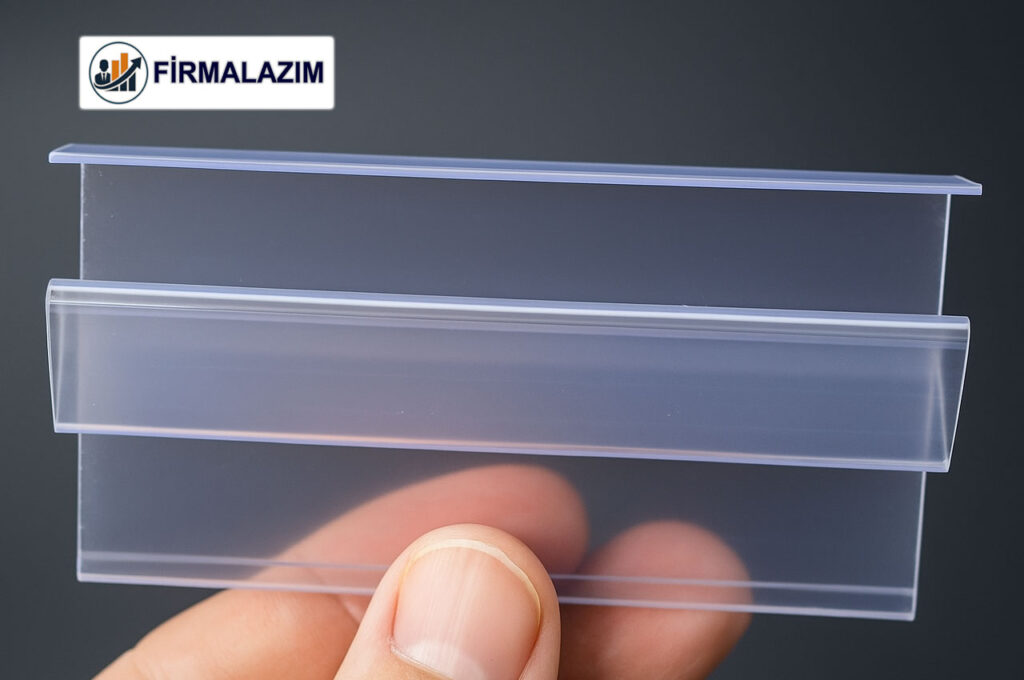
Transparent channels must preserve barcode readability while protecting paper labels from moisture. Firmalazım controls cooling rates during extrusion to minimize internal haze that can obscure small promotional text.
Design Profiles for Different Retail Formats
Dense urban minimarkets require low-profile front-clip systems that maximize product face space. Firmalazım develops single-handed insertion geometries that reduce labor time during rapid price changes driven by currency or promotional cycles.
Large-format and warehouse-style outlets favor deeper channels capable of carrying oversized promotional cards alongside standard price tags. Firmalazım reinforces channel walls against lateral forces generated when heavy cases slide along shelves.
Pharmacy and specialty formats need narrower, higher-security holders to prevent displacement during frequent small-item retrieval. Firmalazım adjusts retention angles and vertical grip specifically for these denser, lower-height runs.
Production Process Control and Traceability
Firmalazım operates continuous extrusion for channel profiles and injection molding for clips, end caps, and multi-position carriers. Dimensional checks occur at multiple stations against the range of shelf-edge thicknesses found in Nigerian fixtures.
Batch traceability links finished holders to specific resin lots and process windows. This capability allows rapid isolation of any field issues and supports quality documentation requested by national chains.
Tooling changeovers are sequenced to support both high-volume standard runs and limited custom programs for branded color or embossed identity elements.
Compatibility Across Mixed Shelf Fleets
Many stores operate combinations of European-style gondolas, locally welded frames, and older particle-board units. Firmalazım designs universal clip and channel geometries that engage reliably across this spectrum without permanent modification of the shelf edge.
Transition adapters enable progressive upgrades so operators can convert sections without discarding functional existing hardware. Firmalazım supplies these components as part of larger roll-out packages.
Magnetic-backed variants attach to steel shelving for temporary promotions or frequent layout changes. Firmalazım calibrates magnet strength to hold under vibration from nearby refrigeration while still permitting easy repositioning.
Total Cost of Ownership Analysis
Unit purchase price represents only the starting point. Firmalazım constructs multi-year models that incorporate observed breakage rates under Nigerian traffic loads, labor minutes required for label changes, and the cost of missing or shifted price information at checkout.
Higher wall-thickness or reinforced-clip profiles raise initial cost yet lower replacement frequency in high-density locations. Firmalazım quantifies the crossover point at which the more durable specification becomes the lower lifetime option.
Volume pricing for new-store packages is structured separately from ongoing maintenance quantities. Firmalazım aligns logistics so secondary-city reorders remain practical.
Installation Practices Under Operational Constraints
Night-shift teams frequently install holders during resets or before openings. Firmalazım designs snap-fit and mechanical systems that require only basic hand tools and avoid adhesives that fail in humid conditions or leave residue.
Positive tactile feedback confirms correct seating. Firmalazım documentation emphasizes orientation and spacing that maintain readable viewing angles from typical customer positions.
Modular sections allow replacement of individual damaged holders without dismantling an entire shelf run, limiting disruption during trading hours.
Maintenance Realities and Surface Performance
Daily wiping with common cleaners and accumulation of product dust stress holder surfaces. Firmalazım selects finishes that resist micro-cracking and clouding under these regimes.
Condensation cycles in refrigerated sections accelerate fatigue. Firmalazım validates specific profiles through accelerated humidity and temperature protocols approximating multi-year service in Nigerian cold-chain environments.
Isolated replacement capability keeps overall system uptime high even when individual clips or channels eventually fail.
Transition Pathways Toward Electronic Shelf Labels
Electronic shelf-label adoption is advancing in higher-end urban stores. Firmalazım produces dual-purpose holders that secure both paper tags and electronic modules during multi-year conversion periods.
Channel geometry accommodates power and data routing while protecting cables. Clear access points allow battery or module service without complete holder removal.
Hybrid installations remain common as chains convert aisle by aisle. Firmalazım supplies transition hardware that preserves visual consistency across mixed paper and digital sections.

Field Durability Under Peak Density Conditions
Urban stores experience intense customer pressure during promotional weekends and salary cycles. Firmalazım subjects holders to accelerated wear that combines repeated label insertions with incidental contact forces.
Reinforced contact zones and controlled edge radii reduce both product damage and customer interaction issues. Pharmacy environments receive higher vertical retention validation to counteract frequent retrieval of small items.
Observed local failure modes drive iterative design updates rather than reliance solely on generic international test protocols.
Customization for Chain Identity and Category Needs
National operators request color-matched or embossed holders to reinforce brand consistency across locations. Firmalazım runs limited custom tooling while preserving capacity for high-volume standard transparent and white profiles used by independent retailers.
Category-specific variants address liquor, frozen, and high-value electronics sections through adjusted retention force, visibility, and anti-tamper features. Temporary promotional extensions attach and detach without permanent alteration of the base system.
Safety Geometry and Compliance Considerations
Holders must avoid sharp edges and ensure that any fractured fragments do not create cutting hazards. Firmalazım designs accordingly and selects materials suitable for proximity to open food displays.
Fire-performance characteristics of polymers become relevant in enclosed mall environments. Firmalazım provides material documentation to support landlord and insurance requirements.
Comparative Positioning of Local Versus Imported Supply
Imported systems can offer refined surface aesthetics developed for different climatic and handling regimes. Firmalazım concentrates on mechanical robustness under local traffic patterns and the practical advantage of rapid domestic replacement support.
Currency and logistics variables can reverse short-term import cost advantages. Firmalazım’s production model reduces exposure to these external factors for operators managing simultaneous multi-state openings.
Field observations from multi-store operators indicate that locally supported holders lower the frequency of complete edge-system replacements.
Labor Productivity and Pricing Accuracy Effects
Insertion force and clear engagement feedback directly influence staff time during price updates. Firmalazım geometries engineered for low force and positive confirmation reduce minutes per shelf.
Secure retention prevents progressive shifting or loss of labels. Accurate shelf pricing lowers checkout disputes and associated supervisory overhead.
Across large-format stores the cumulative labor savings become measurable in weekly operational costs.
Procurement Decision Risks and Specification Pitfalls
Lowest-unit-price selection frequently increases lifetime cost through higher breakage and more frequent interventions. Firmalazım presents failure-mode distributions drawn from comparable Nigerian installations so decision-makers can weigh durability against initial outlay.
Over-specification of premium finishes in high-volume discount formats misallocates capital. Firmalazım advises matching holder grade to store positioning, expected traffic intensity, and typical label-change frequency.
Lead-time exposure for fully imported systems rises during port congestion or currency restriction periods. Firmalazım’s local capacity mitigates this variable for time-sensitive roll-outs.
Capacity Response to National Expansion Programs
When supermarket groups announce concurrent openings across multiple states, demand for holders can spike sharply. Firmalazım maintains surge capability on extrusion and molding lines and coordinates logistics experienced in last-mile delivery to secondary cities.
Production sequencing supports parallel supply of standard profiles and limited custom elements under compressed timelines, reducing the risk of delayed store openings.
Sustainability Trajectory and Material Development
Recycled-content polymer streams are under evaluation as collection infrastructure develops. Firmalazım tests post-consumer resin blends for mechanical performance, dimensional stability, and visual consistency under retail conditions.
Modular dual-purpose designs extend the service life of installed hardware during digital transitions, reducing the volume of discarded holders. Firmalazım prioritizes forward-compatible geometries that support progressive conversion rather than wholesale system replacement.
Investment and Strategic Supply Considerations for Operators
Consistent shelf presentation protects pricing credibility and reduces operational friction. Firmalazım positions its holders as infrastructure that supports accurate merchandising rather than pure consumable hardware.
Operators planning multi-year expansion benefit from suppliers capable of both volume scaling and design iteration based on direct Nigerian store feedback. Firmalazım structures its production and support model around these dual requirements, providing a practical domestic manufacturing option within a market still heavily reliant on imported edge systems.
Supermarket and retail operators across Nigeria require shelf-edge systems that keep price tags, promotional cards, and product identifiers secure under continuous handling, humidity variation, and high customer density. Firmalazım manufactures holders specifically for these conditions, supplying profiles that fit the mixed imported and locally fabricated gondolas common in Lagos, Abuja, Port Harcourt, and expanding secondary markets.
Modern trade formats continue to gain share from traditional open markets. Each new or renovated store needs reliable edge identification that supports frequent price changes driven by currency movements and promotional cycles. Firmalazım designs retention and visibility characteristics around these operational realities rather than generic international catalog standards.
Core Functional Requirements in Nigerian Store Environments
Holders must remain functional in both fully air-conditioned urban stores and partially cooled secondary locations. Firmalazım selects polymer formulations that retain clip force and dimensional stability across these temperature and humidity ranges.
Barcode readability under mixed fluorescent and LED lighting is non-negotiable. Transparent channels produced by Firmalazım maintain optical clarity so scanners and customers can read small-print information without obstruction.
Accidental customer contact and staff restocking forces occur constantly. Firmalazım reinforces contact zones and edge radii to reduce both product damage and progressive loosening of snap-fit joints.
Material Performance Under Local Stress Loads
Polypropylene-ABS blends dominate high-cycle applications because they resist stress whitening after thousands of label insertions. Firmalazım validates these compounds against observed wear patterns in dense Lagos minimarkets.
Polycarbonate channels protect labels from condensation in refrigerated sections while preserving full visibility. Controlled cooling during extrusion limits internal haze that can obscure promotional text.
Aluminum extrusions receive powder coatings formulated for low fingerprint visibility and resistance to residual product oils. Firmalazım tests adhesion against the detergents commonly used by store cleaning teams.
Profile Geometries Matched to Store Formats
Narrow urban minimarkets require low-profile front-clip systems that leave maximum product face space. Firmalazım develops single-handed insertion designs that reduce labor minutes during rapid price updates.
Large-format and warehouse-style outlets favor deeper channels capable of carrying oversized promotional cards alongside standard price tags. Reinforced walls resist lateral forces generated when heavy cases slide along shelves.
Pharmacy and specialty formats demand narrower, higher-security holders. Firmalazım adjusts vertical retention angles specifically for the denser, lower-height shelf runs typical of these categories.
Production Methods and Quality Control
Firmalazım runs continuous extrusion for channel profiles and injection molding for clips, end caps, and multi-position carriers. Dimensional verification occurs against the range of shelf-edge thicknesses found in Nigerian fixtures.
Batch traceability links finished holders to specific resin lots and process windows. This supports rapid isolation of any field issues and meets documentation requests from national chains.
Tooling sequences accommodate both high-volume standard runs and limited custom programs for branded color or embossed identity elements without extended changeover times.
Compatibility with Existing Fixture Fleets
Many stores operate combinations of European-style gondolas, locally welded steel frames, and older particle-board units. Firmalazım designs universal clip and channel geometries that engage reliably across this spectrum.
Transition adapters enable progressive upgrades so operators can convert sections without discarding functional existing hardware. Firmalazım supplies these as part of larger roll-out packages.
Magnetic-backed variants attach to steel shelving for temporary promotions or frequent layout changes. Magnet strength is calibrated to hold under refrigeration vibration while still allowing easy repositioning.
Total Cost Modeling for Procurement Teams
Initial unit price forms only the starting metric. Firmalazım constructs three-to-five-year models that incorporate observed breakage rates, labor time for label changes, and the cost of missing or shifted price information at checkout.
Higher wall-thickness or reinforced-clip profiles raise purchase cost yet lower replacement frequency in high-density locations. The crossover point where the more durable specification becomes the lower lifetime option is quantified for typical Nigerian traffic loads.
Volume pricing for new-store packages is structured separately from ongoing maintenance quantities. Logistics alignment keeps secondary-city reorders practical.
Installation Under Time and Labor Constraints
Night-shift teams frequently install holders during resets or before openings. Firmalazım designs snap-fit and mechanical systems that require only basic hand tools and avoid adhesives that fail in humid conditions or leave residue.
Positive tactile feedback confirms correct seating. Orientation and spacing guidance focuses on maintaining readable viewing angles from typical customer positions.
Modular sections allow replacement of individual damaged holders without dismantling an entire shelf run, limiting disruption during trading hours.
Maintenance Cycles and Surface Longevity
Daily wiping with common cleaners and accumulation of product dust place continuous stress on surfaces. Firmalazım selects finishes that resist micro-cracking and clouding under these regimes.
Condensation cycles in refrigerated and frozen sections accelerate fatigue. Specific profiles are validated through accelerated humidity and temperature protocols approximating multi-year service in Nigerian cold-chain environments.
Isolated replacement capability keeps overall system uptime high even when individual clips or channels eventually fail.
Hybrid Support for Electronic Shelf Labels
Electronic shelf-label adoption is progressing in higher-end urban stores. Firmalazım produces dual-purpose holders that secure both paper tags and electronic modules during multi-year transition periods.
Channel geometry accommodates power and data routing while protecting cables from incidental contact. Clear access points allow battery or module service without complete holder removal.
Stores converting aisle by aisle retain the ability to mix formats on the same gondola. Transition hardware preserves visual consistency across hybrid installations.
Durability Validation Under Peak Traffic
Urban stores experience intense density during promotional weekends and salary-cycle peaks. Firmalazım subjects holders to accelerated wear that combines repeated label insertions with incidental customer contact forces.
Reinforced contact zones and controlled edge radii reduce both product damage and customer interaction issues. Pharmacy environments receive higher vertical retention validation to counteract frequent retrieval of small items.
Observed local failure modes inform iterative design updates rather than reliance solely on generic international test standards.
Customization Pathways for Brand Consistency
National chains request color-matched or embossed holders to reinforce store identity across multiple locations. Firmalazım runs limited custom tooling while preserving capacity for high-volume standard transparent and white profiles used by independent operators.
Category-specific variants address liquor, frozen, and high-value electronics sections through adjusted retention force, visibility, and anti-tamper features. Temporary promotional extensions attach and detach without permanent alteration of the base system.
Safety Geometry and Material Suitability
Holders must avoid sharp edges and ensure that any fractured fragments do not create cutting hazards. Firmalazım designs accordingly and selects materials suitable for proximity to open food displays.
Fire-performance characteristics of polymers become relevant in enclosed mall environments. Material documentation is provided to support landlord and insurance requirements.
Local Production Versus Import Dynamics
Imported holders can present refined surface aesthetics developed for different climatic and handling regimes. Firmalazım concentrates on mechanical robustness under local traffic patterns and the practical advantage of rapid domestic replacement support.
Currency and logistics variables can reverse short-term import cost advantages within a single season. Domestic production reduces exposure to these external factors for operators managing simultaneous multi-state openings.
Field data from multi-store operators indicates that locally supported systems lower the frequency of complete edge-system replacements.
Labor Efficiency and Pricing Accuracy Impacts
Insertion force and clear engagement feedback directly influence staff productivity during price updates. Firmalazım geometries engineered for low force and positive confirmation reduce minutes per shelf.
Secure retention prevents progressive shifting or loss of labels. Accurate shelf pricing lowers checkout disputes and the supervisory overhead associated with corrections.
Across large-format stores the cumulative labor minutes saved translate into measurable weekly operational effects.
Procurement Risk Factors and Specification Choices
Selecting holders solely on lowest unit price frequently increases lifetime cost through elevated breakage and more frequent interventions. Firmalazım presents failure-mode distributions from comparable Nigerian installations so decision-makers can weigh durability against initial outlay.
Over-specification of premium finishes in high-volume discount formats misallocates capital. Matching holder grade to store positioning, expected traffic intensity, and typical label-change frequency produces better outcomes.
Lead-time risk for fully imported systems rises during port congestion or currency restriction periods. Local capacity mitigates this variable for time-sensitive roll-outs.
Scaling Capacity for Multi-Location Expansions
When supermarket groups announce concurrent openings across multiple states, holder demand can spike sharply. Firmalazım maintains surge capability on extrusion and molding lines and coordinates with logistics partners experienced in last-mile delivery to secondary cities.
Production sequencing supports parallel supply of standard profiles and limited custom elements under compressed timelines, reducing the risk of delayed openings.
Sustainability Considerations and Forward Compatibility
Recycled-content polymer streams are under evaluation as collection and processing infrastructure develops. Firmalazım tests post-consumer resin blends for mechanical performance, dimensional stability, and visual consistency under retail conditions.
Modular dual-purpose designs extend the service life of installed hardware during digital transitions, reducing the volume of discarded holders. Forward-compatible geometries support progressive conversion rather than wholesale system replacement.
Technical Interoperability Across Fixture Variations
Shelf-edge thickness and profile geometry vary widely across imported European gondolas and locally fabricated frames. Firmalazım maintains tolerance bands that accommodate the majority of common Nigerian fixtures without requiring custom machining for each installation.
Clip engagement depths and retention forces are validated against both particle-board and steel shelf edges. Compatibility ranges are published so store planners can specify holders with confidence across mixed fleets.
End-cap and connector systems are designed for field assembly without specialized fixtures, remaining functional even when shelves exhibit minor warpage or manufacturing variation common in rapid local fabrication.
Regional Environmental Adaptation
Coastal stores face higher ambient humidity and salt-laden air. Coating formulations and polymer stabilizers are adjusted for these conditions while maintaining the same mechanical performance envelope used inland.
Northern and inland locations experience greater diurnal temperature swings. Thermal expansion compatibility is validated so snap-fit joints do not loosen progressively under repeated heating and cooling cycles.
Secondary-city stores often operate with less consistent air-conditioning and higher dust loads. Surface finishes and channel geometries are prioritized to tolerate these environments without accelerated degradation of label visibility or retention.
Strategic Supply Positioning for Operators
Consistent shelf presentation protects pricing credibility and reduces operational friction. Firmalazım positions its holders as infrastructure that supports accurate merchandising rather than pure consumable hardware.
Operators planning multi-year expansion benefit from suppliers capable of both volume scaling and design iteration based on direct Nigerian store feedback. The production and support model is structured around these dual requirements, offering a practical domestic manufacturing option within a market that continues to rely heavily on imported edge systems for certain profiles.